
In
Uganda, the climate crisis is not just an environmental challenge, it is a
youth emergency. Floods, droughts, and displacement are disrupting education,
deepening poverty, and threatening the futures of millions of young people. Yet
in the face of these challenges, youth remain one of Uganda’s greatest untapped
resources. Their energy, creativity, and proximity to community realities
position them as natural problem-solvers. But without the right tools,
platforms, and support, their potential risks being lost.
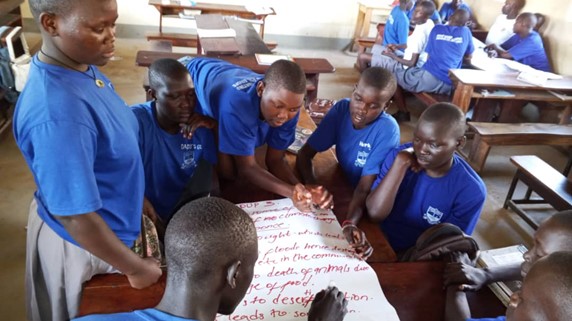
Humanity Horizons launched the Education Sector Reform & Policy Development Program (ERPDP) to change that. At its core is a bold commitment to Student Empowerment not as a side benefit, but as the engine of climate resilience and education reform. Through ERPDP, secondary school students are enrolled into a transformative, year-long journey as Green Intellectuals a flagship identity that blends climate literacy, entrepreneurship, civic responsibility, and leadership development.
The
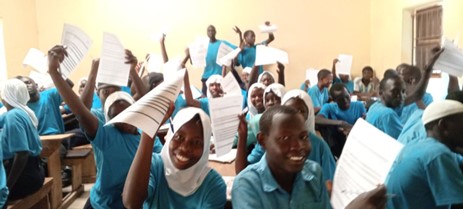
Green Intellectuals program is structured around a comprehensive Climate Change and Entrepreneurship Course,
delivered across three academic terms. Students engage with four integrated
components: Climate Change Adaptation & Mitigation (30%), Entrepreneurship
(20%), Disaster Risk Reductions (DRR) (20%), and Student-Led Projects (30%).
This balance ensures that learners not only understand the science and
economics of climate change, they also apply it through real-world action.
And
the beating heart of this transformation is the Climate
Action Hub.
Climate Action Hubs are dynamic, student-led spaces embedded within participating secondary schools. They serve as incubators for critical thinking, innovation, and community engagement. Each hub is co-managed by Green Intellectuals and trained educators, and functions as a launchpad for student-led climate solutions. These hubs are not extracurricular clubs, they are embedded into the academic calendar, aligned with ERPDP’s curriculum, and recognized as formal learning environments.
Within the hubs, students work in teams to identify local climate challenges from water scarcity and waste management to deforestation and food insecurity. They conduct community interviews, gather data, and design interventions. These projects are not hypothetical. They are implemented, monitored, and refined. In Arua Hill, for example, a Climate Action Hub led a solar irrigation pilot that now supports three school gardens and supplies produce to nearby households. In Arua, students launched a menstrual health enterprise that combines climate-smart packaging with peer education, reducing dropout rates and improving sanitation.
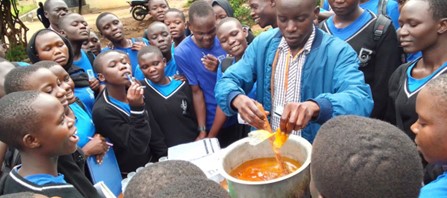
These projects cultivate critical thinking in real time. Students learn to ask better questions, challenge assumptions, and evaluate trade-offs. They debate policy options, analyse environmental data, and present findings to local leaders. They learn to navigate complexity balancing ecological sustainability with economic feasibility, and community needs with long-term impact. This kind of thinking is rare in traditional classrooms. But in Climate Action Hubs, it becomes second nature.
The
hubs also foster collaborative leadership. Students rotate roles from project
manager and communications lead to finance coordinator and community liaison.
They learn to manage teams, resolve conflicts, and build consensus. They
practice public speaking, digital storytelling, and stakeholder engagement.
These are not soft skills. They are survival skills and they prepare youth to
lead in a world shaped by climate volatility and social change.
To
elevate youth voices beyond the school level, ERPDP culminates in the Annual
Student Climate Change Summit a national platform where Green Intellectuals
present their innovations, policy recommendations, and collective demands. This
summit replaces traditional district exhibitions with a more strategic,
youth-led forum that directly influences climate policy and programming.
Held
in partnership with the Youth Climate Council and aligned with Uganda’s Local
Conference of Youth (LCOY), the summit brings together students from across the
country to showcase their work, engage with policymakers, and shape national
climate priorities. In 2025, Green Intellectuals contributed to Uganda’s third
Nationally Determined Contributions (NDCs 3.0), presenting youth-led climate
priorities and monitoring frameworks. Their voices were not only heard, they
helped shape the negotiating table.
The
summit is more than an event. It is a declaration of ownership. Students
present climate communiqués, host thematic panels on green jobs and renewable
energy, and lead workshops on adaptation finance and eco-entrepreneurship.
These engagements are documented, shared with ministries, and used to inform
Uganda’s education and climate strategies.
ERPDP ensures that every Climate Action Hub and summit delegation is inclusive. We prioritize displaced learners, girls, children with disabilities, and youth in informal settlements. We provide multilingual materials, low-tech toolkits, and mentorship support to ensure full participation. This reflects Uganda’s
commitments
under the National Climate Change Act (2021), the National Environment Act
(2019), and the Greening Schools initiative launched by MoES and UNDP.
At
the end of the year, Green Intellectuals graduates not just with certificates,
but with portfolios of impact. They showcase their projects, pitch their
ventures, and present their policy recommendations. Graduation ceremonies are
community-wide events, celebrating youth leadership and launching the next
cohort. These moments are powerful, they signal that resilience is not just
taught, but lived.
The
expected outcomes are clear and measurable:
- Enhanced Climate Literacy: Students gain deep knowledge
of climate change and solutions, leading to informed environmental
stewardship.
- Student-Led Climate Action
Projects:
Green Intellectuals lead hands-on initiatives like school gardens, waste
recycling, and renewable energy pilots.
- Critical Thinking &
Leadership:
Students demonstrate authentic leadership, problem-solving, and the
ability to inspire others.
- Decent Work Opportunities: Youth develop entrepreneurial
solutions that address environmental challenges and create sustainable
livelihoods.
- National Policy Influence: Through the Annual Student
Climate Change Summit, youth shape Uganda’s climate agenda and SDG
commitments.
But
the demand is growing. Across Uganda, youth are asking for platforms, skills,
and support. Schools are requesting empowerment modules. Communities are ready
to co-create solutions. ERPDP is ready. The models are proven. The systems are
in place. What’s missing is the scale of investment required to meet this
moment.
This
is not a moment for tokenism. It is a moment for transformation. Student
empowerment is no longer a side benefit it is the frontline of resilience. And
ERPDP is leading the charge.