
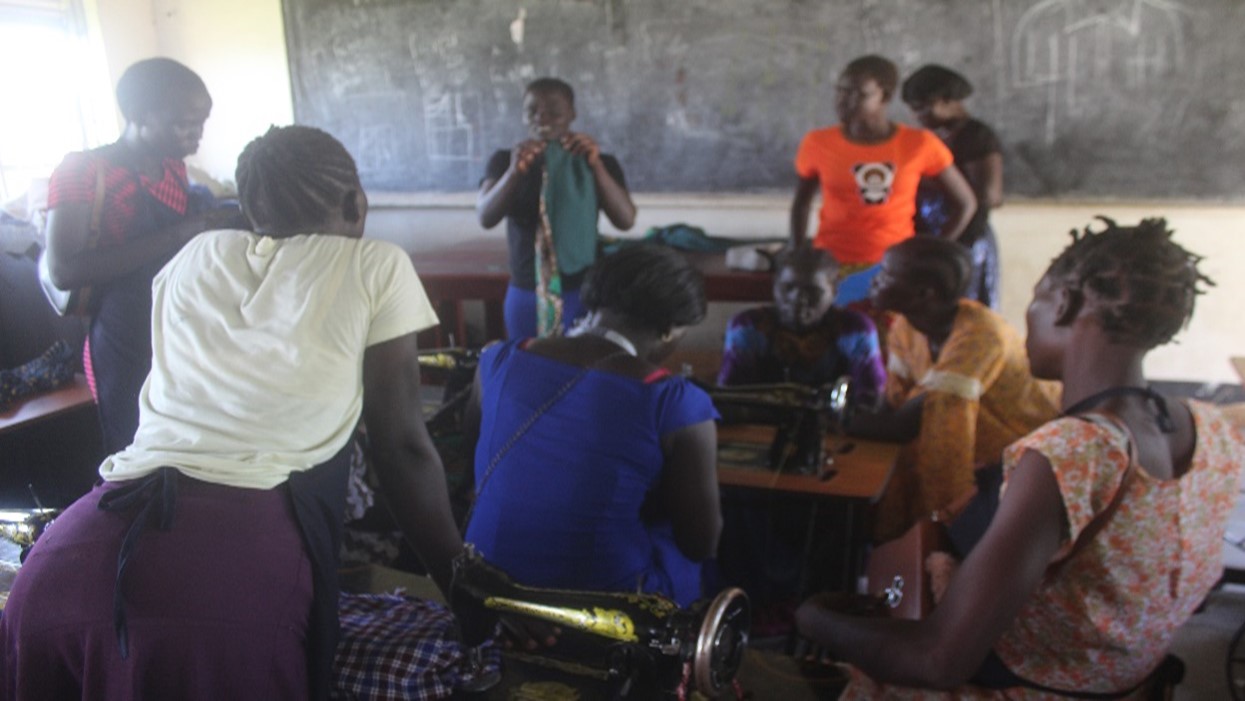
In the crowded trading center of Oluku Sub- County in Arua, 23‑year‑old Daniel once spent his days helping his cousin sell second‑hand clothes. The income was unpredictable, and his dream of running his own business felt impossibly far away. Without formal schooling and with few job opportunities in the area, he was part of a growing number of young people in Uganda facing the same reality high unemployment, limited skills, and shrinking opportunities.
This
is not an isolated story. Uganda has one of the youngest populations in the
world, with over 77% under the age of 25. Yet in rural and refugee‑hosting
districts, youth unemployment rates are alarmingly high. Every year, thousands
of young people leave school or never attend at all without the skills they
need to earn a living. Without intervention, this “skills gap” becomes a
poverty trap, locking entire communities into cycles of dependency and
vulnerability.
The
urgency is clear: without immediate, targeted action, we risk losing an entire
generation’s potential. Young people who could be powering solar grids, running
agribusinesses, or building climate‑resilient infrastructure are instead left
idle, underemployed, or forced into unsafe, exploitative work. The economic and
social costs of inaction are staggering not just for individuals, but for
Uganda’s future.
Humanity
Horizons’ Vocational Training Skills component under the Roots of Resilience
Program is designed to break this cycle. We bring training directly into
communities, removing barriers of distance and cost. Our SDG hubs are within
walking distance, schedules are flexible, and courses are practical, hands‑on,
and tailored to the realities of rural and peri‑urban economies.
We start by mapping local and regional market demand, ensuring that every skill taught has a clear pathway to income. This means training in trades and sectors with strong growth potential and climate relevance, such as renewable energy installation, carpentry, tailoring, agribusiness, catering, digital literacy, and motorbike repair. These are not abstract skills, they are the ones that communities need now, and that can generate income immediately after graduation.
But technical skills alone are not enough. Every course includes entrepreneurship, financial literacy, and life skills. Participants learn how to manage money, plan a business, communicate effectively, and solve problems. For those with limited formal education, we integrate functional literacy and numeracy so that no one is left behind.
Equality,
Justice & Inclusion (EJI) is at the core of our approach. Women, persons
with disabilities, refugees, and survivors of gender‑based violence are
actively recruited and supported. We work with community leaders to address
cultural barriers, provide childcare options, and create safe learning
environments. In refugee‑hosting areas, training hubs are open to both refugees
and host community members, fostering peaceful co‑existence and shared economic
growth.
The
urgency of this work is amplified by the fact that every graduate becomes a
multiplier. Many go on to employ others, mentor new trainees, and form peer
learning groups that share resources and collaborate on larger contracts. This
ripple effect means that a single training opportunity can transform not just
one life, but an entire community’s economic prospects.
We
have already seen the impact. Young women have opened tailoring shops that
employ others. Formerly unemployed youth are running solar installation
businesses. Refugees have started catering services that supply local schools
and events. These are not isolated successes, they are part of a growing
ecosystem of skilled, confident, and economically active community members.
Yet
the demand far outstrips our current capacity. In every community we enter, the
waiting list for training is long. Young people are ready to learn, ready to
work, and ready to lead but without the resources to expand, too many are
turned away. Every month that passes without scaling up means more lost
opportunities, more wasted potential, and more young people left behind.
This is why we are calling on partners, donors, and changemakers to act now. The Vocational Training Skills component is not just about teaching trades, it is about unlocking human potential, driving local economies, and building resilience from the ground up. It is about ensuring that the next generation is equipped not only to survive, but to lead their communities into a more sustainable, equitable future.
The
window for action is open, but it will not stay open forever. With the right
investment today, we can transform the trajectory of thousands of young lives
and set entire communities on a path to prosperity. Without it, the costs in
lost talent, stalled economies, and deepened inequalities will be felt for
decades.
Now
is the time to invest in skills, in opportunity, and in the future of Uganda’s
youth. Because when skills meet opportunity, transformation follows and
resilience takes root.